Our experts continuously work on power systems problems, and we share solutions with Practical Reference Articles.
The main topics are earthing system modeling, power cable ratings, HV/LV electrical design, protective device coordination, and arc flash studies. We cover IEC and IEEE standards.
Join 23K+ engineers and get our latest technical articles direct to your inbox as they are released – Jayson Patrick
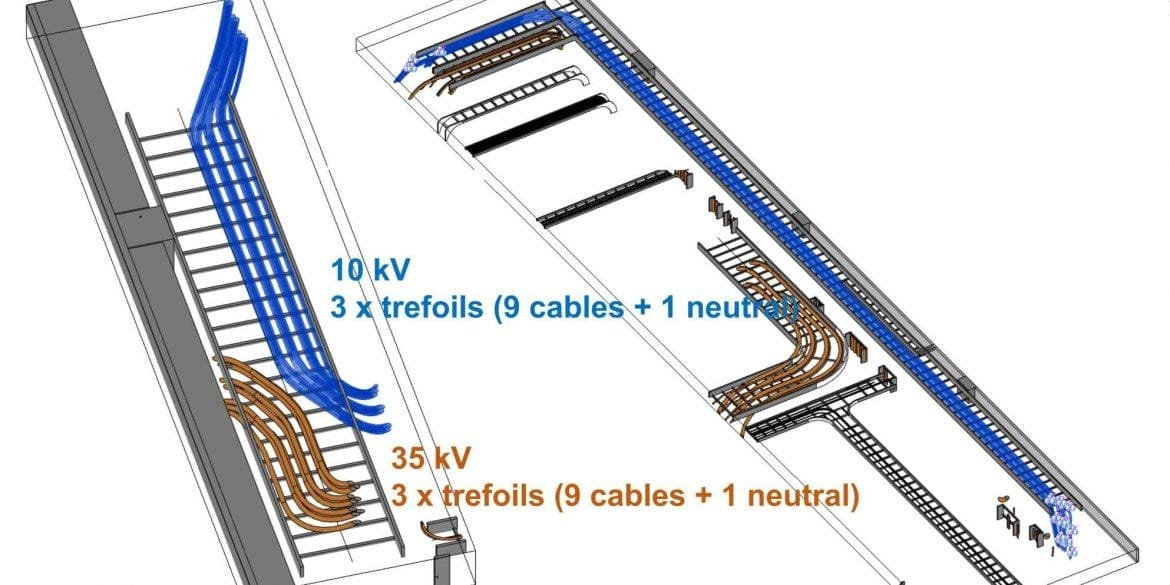
The calculation of current ratings for groups of (multiple) cable circuits require the quantification of the mutual heating component between the groups of circuits. This example is for multiple groups of circuits in air on the same cable ladder. This article will discuss the IEC 60287 approach.
The new maximum demand module provides fast and accurate calculations for loads in accordance with rules from the Standards and for custom loads. An ingenious automatic phase balancing algorithm ensures maximum demand and phase imbalance are both minimised.
This article explains how to calculate the current rating of cables in J-tubes. Typically J-tubes are the thermal bottleneck of submarine power cable routes.
Based on extensive field experience, this article recommends the best materials for cable trays for use in offshore facilities such as offshore wind, solar, and oil rigs.
The effects of lightning strikes on earthing or protection systems designed to IEC 62305 can be modelled using an equivalent single frequency from 25kHz up to 1MHz which gives similar results to a time-domain approach. This article provides the frequency and current values to be used for modelling lightning.
New 13 kV power circuits will be installed in an unfilled trough with ventilated covers. These new circuits will cross with existing buried 400 kV cables at approximately 90 degrees with a continuous current rating requirement of 1136 MVA (1640 A) per phase for all seasons.
To show how and when earthing rods can be used to improve the safety of earthing grids by reducing the grid resistance and potential rise (GPR) as well as surface, step and touch potentials.
This article shows the effects of soil resistivity and thickness of layers on grid resistance for earthing systems in multilayer soils. Increasing the resistivity of soil layers tends to increase the grid resistance, no matter which soil layer that is. Increasing the thickness of any soil layer with high resistivity also increases grid resistance and if the soil layer thickness is increased for a low resistivity layer then the grid resistance will decrease. Software modelling is performed and the results are compared and shown to match well with those from CDEGS software.