Table of Contents
Cable sizing is one of the most common electrical design calculations. To comply with the applicable standards, a cable must satisfy requirements for current-carrying capacity, voltage drop, short-circuit withstand, earth-fault loop impedance, and protective-device sizing.
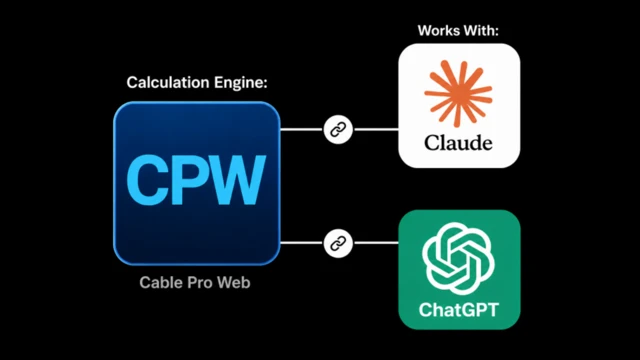
General-purpose AI tools such as ChatGPT and Claude can interpret cable-sizing requests but cannot reliably perform standards-based calculations on their own. ELEK Cable Pro Web AI (“ELEK AI”) connects a large language model (LLM) to ELEK’s validated cable-sizing engine through a Model Context Protocol (MCP) server. The LLM interprets the natural-language request, while the calculation engine applies the standards, engineering rules, and required checks.
This article explains how to construct an effective cable-sizing prompt and presents two case studies comparing Claude used alone with Claude connected to ELEK AI.
Claude produced confident answers in both cases, but neither was fully reliable. In the first, the final cable size was coincidentally correct, despite using the wrong standards edition and producing incorrect intermediate results, including voltage drop. In the second, Claude undersized the active conductor and produced incorrect intermediate calculations. Using the same prompts, ELEK AI returned correct results supported by detailed, standardised reports.
The tests were conducted in August 2026 using the cable-sizing MCP in ELEK Cable Pro Web™ software, with Claude Opus 5 as the LLM in both workflows.
Why a general-purpose AI cannot do cable sizing on its own
General-purpose AI has critical limitations in specialised engineering tasks such as cable sizing:
- No licensed table access. Without authorised standards data, values may be inferred rather than retrieved.
- Non-deterministic answers. Plausible but incorrect values can result in the wrong cable size.
- No revision control. Calculations cannot be reliably traced to the required edition of the standards.
- No constraint enforcement. Invalid combinations of conductor, insulation, or installation may be proposed.
- No guaranteed verification. Mandatory safety and performance checks may be missed.
- Inconsistent units and rounding. Small errors can change the selected conductor size.
- Limited auditability. Outputs may lack recorded inputs, reports, and source-table references.
Through an MCP server, general-purpose AI can call ELEK AI whenever cable sizing is requested. ELEK AI’s purpose-built calculation engine selects the correct tables, applies correction factors, performs the required checks, and returns a verified, auditable result.
What should be included in the prompt for accurate cable sizing
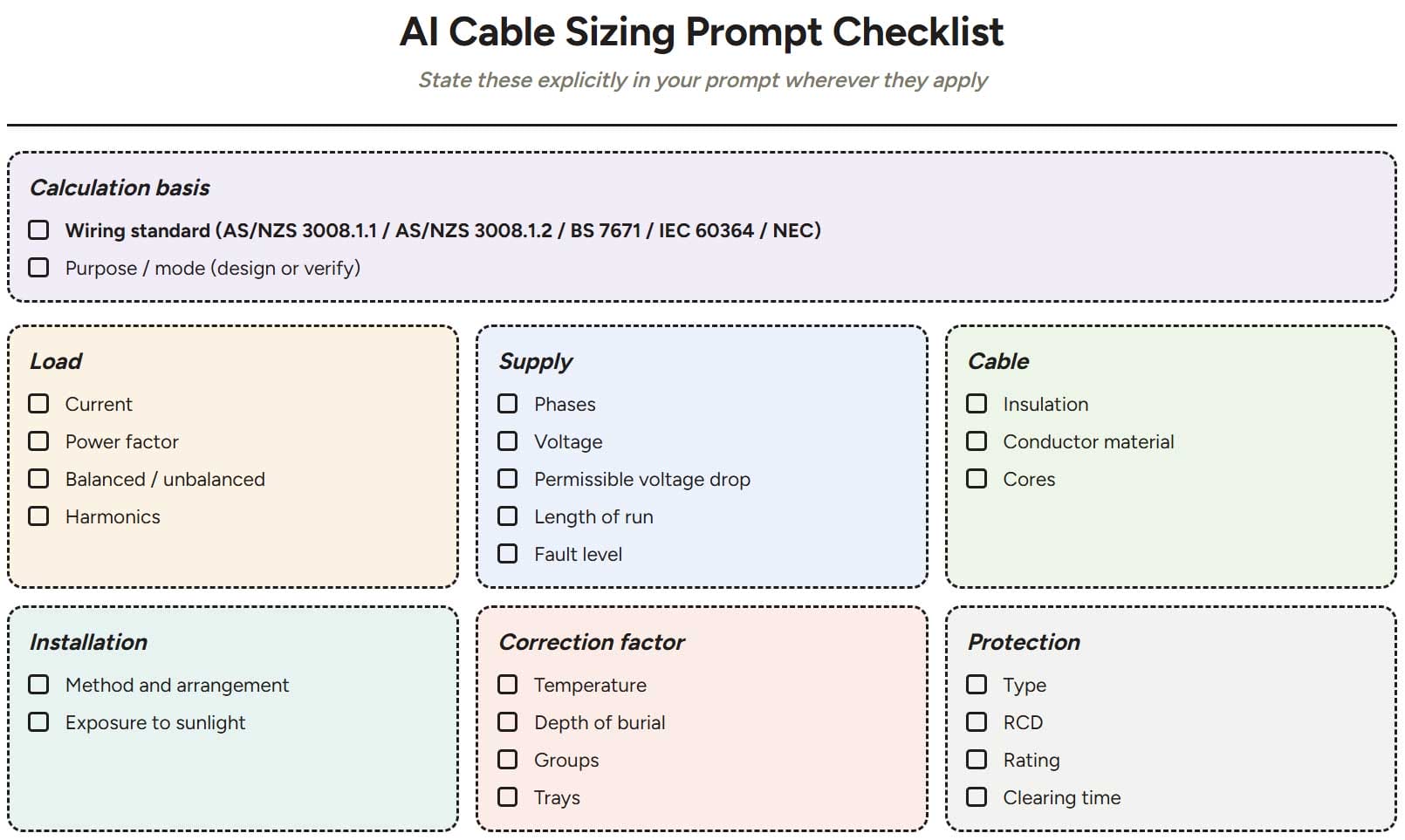
Accurate cable sizing begins by identifying the applicable wiring standard, which governs all subsequent calculations. You should then provide the relevant project inputs across six categories: load, supply, cable, installation, correction factors, and protection.
When information is missing, both general-purpose AI and ELEK AI must make assumptions. However, a general-purpose AI may infer values without consistently validating or disclosing them. ELEK AI instead uses predefined, engineering-reviewed defaults and records every assumed value in its report. These values can be changed with a follow-up prompt.
You can proceed when some project details are unknown, but you should review all assumptions before relying on the result. The more information you provide, the fewer assumptions the calculation requires.
Use the checklist below to structure your prompt.
Case studies: ELEK AI vs a standalone LLM
This section presents two case studies based on worked examples from Appendix A of AS/NZS 3008.1.1:2025. Refer to the step-by-step cable sizing calculation guide for detailed manual cable-sizing calculations. The calculations were also independently reproduced in ELEK Cable Pro Web software to confirm the published results.
Case study methodology
- Create a prompt for each case using the AI Cable-Sizing Prompt Checklist.
- Submit the same prompt to Claude Opus 5 in two configurations: standalone and connected to ELEK AI through the cable-sizing MCP.
- Use the published worked examples as the reference results and verify them independently in ELEK Cable Pro Web.
- Compare the selected cable sizes and the results of each compliance check.
- Analyse any differences and draw a conclusion for each case.
Note: Both workflows used Claude Opus 5, ensuring that the comparison measured the effect of access to ELEK’s validated calculation engine—not differences between LLMs. At the time of testing in August 2026, Claude Opus 5 offered a strong balance of prompt interpretation and cost. ELEK AI can also be used with ChatGPT, with models such as Sol 5.6 as alternatives.
Case study 1: minimum conductor size for bunched flat cables carrying continuous loads
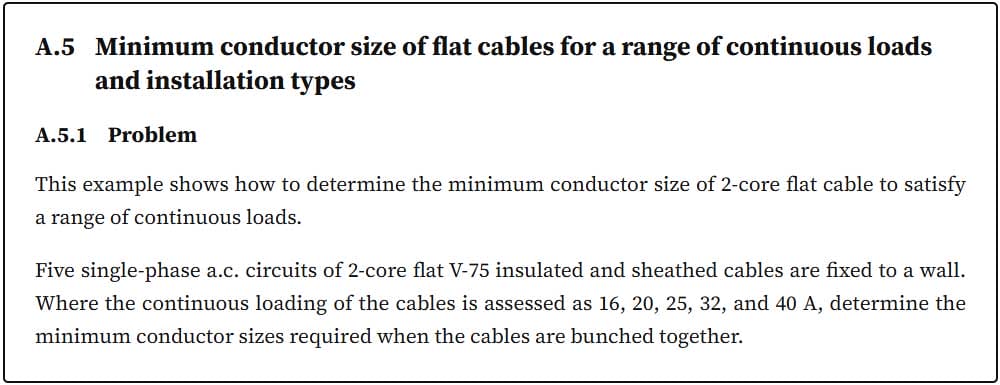
Per Australian standard 3008, five single-phase 230 V circuits in 2-core flat V75 copper cable, clipped to a wall and bunched together, 20 m per circuit. Continuous loads are 16, 20, 25, 32 and 40 A. The maximum ambient temperature is 40 degrees. Size each circuit independently and report the conductor size for each load.
Figure 2: Prompt used for case study 1.
Assumptions and additional checks
- Cable length: No length was specified, so 20 m was used as a representative installation length.
- Voltage drop: No limit was specified. ELEK AI applied its documented default of 2.5%; any assumption made by the standalone LLM could not be confirmed.
- Ambient temperature: Both workflows assumed 40 °C, the standard reference temperature at which no correction factor is required.
- Short-circuit withstand: Although not requested, ELEK AI performed this check by default. The standalone LLM did not.
- Supplementary inputs: A 230 V supply and copper conductors were assumed. A manual calculation using these values produced the same cable sizes as the published example, supporting their suitability.
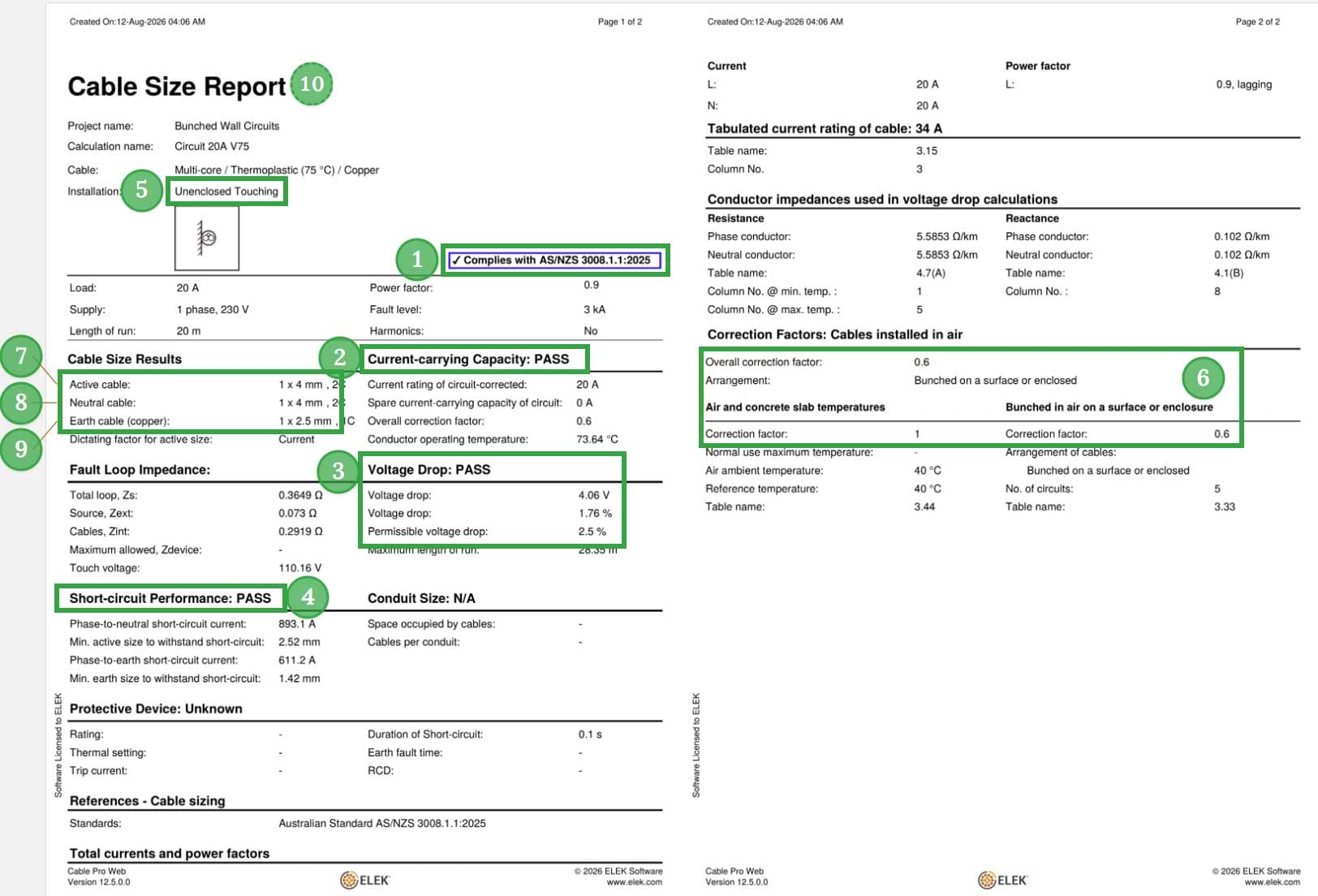
The following evaluation compares Claude Opus 5 operating as a standalone LLM with the same model connected to ELEK AI. Both workflows received the same prompt and were benchmarked against calculations completed by an experienced engineer in accordance with AS/NZS 3008.1.1:2025. The detailed comparison below uses the second cable, which carries a design current of 20 A.
| Answer | ELEK AI |
General-purpose LLM (Claude Opus 5) |
||||
|---|---|---|---|---|---|---|
| 1 | Standard | AS/NZS 3008.1.1:2025 | AS/NZS 3008.1.1:2025 | AS 3008.1.1:2017 | ||
| 2 | Current-carrying Capacity Table | current rating (tabulated): 34 A; Table 3.15, column 3 | Current rating of circuit-corrected: 20 A | ~36 A, approximate (no table cited); Derated Iz: 21.6 A | ||
| 3 | Voltage Drop | 4.06 V; 1.76 % | 4.06 V; 1.76 %, pass the default permissible 2.5 % | 4.5 V (1.9 %), not correct; 5 % limit assumed | ||
| 4 | Short-circuit Performance | active: 2.34 mm² neutral: 2.34 mm² earth: 1.44 mm² | Check the K factor from the latest standard and verify the minimum cross-sectional area by the equation: I²t = K²S² | Not addressed | ||
| 5 | Installation | Unenclosed Touching | Unenclosed Touching | Described in prose, didn’t refer to the specific method in the standard | ||
| 6 | Correction Factor | 0.6 overall: 1 ambient (Table 3.44) × 0.6 grouping (Table 3.33) | 0.6 overall; 1 ambient (Table 3.44); 0.6 grouping (Table 3.33) | 0.6 overall 1 ambient (doesn’t specify the table) × 0.6 grouping (Table 22, AS 3008, 2017) | ||
| 7 | Active Size | 4 mm² (Load: 20 A) | 4 mm² (Load: 20 A) | 4 mm² (Load: 20 A) | ||
| 8 | Neutral Size | 4 mm² | 4 mm² | Not sized | ||
| 9 | Earth Size | 2.5 mm² | 2.5 mm² | Not sized | ||
| 10 | Deliverable | Formatted report | Stamped PDF report with table references | Chat prose | ||
| 11 | Score | - | 10/10 | 2/10 | ||
The results demonstrate that ELEK AI consistently delivers accurate calculations, whereas the general-purpose LLM failed to produce reliable results across most parameters. A detailed comparative analysis follows.
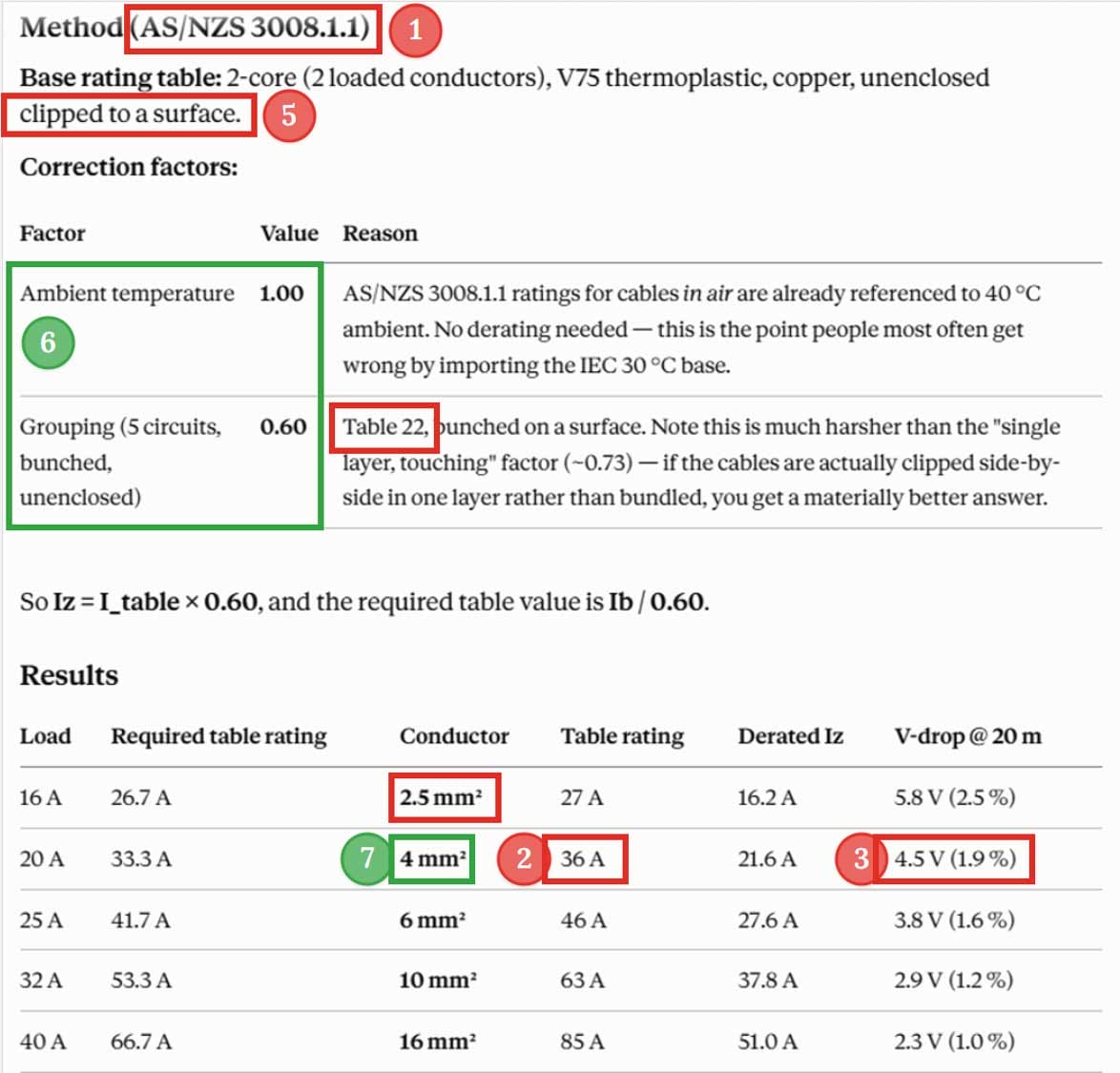
The general-purpose LLM’s output referenced outdated tables (e.g., “Table 22”) from the 2017 edition rather than the current AS/NZS 3008.1.1:2025 standard. Furthermore, cross-verification of the LLM’s figures reveals significant inaccuracies; for instance, it reported 36 A, whereas the standard specifies 34 A. Such discrepancies indicate that the model provides approximations rather than directly using the data from the standard tables.
Notably, the model utilised superseded tabulated values to determine the final conductor size. For a 16 A load, it selected a 2.5 mm² cross-section, which was permissible under the 2017 edition but is non-compliant with the 2025 standards. The current edition derates 2.5 mm² cable to 15.6 A, falling short of the required 16 A design current. This discrepancy occurred because the model applied outdated parameters without specifying the reference edition. Consequently, it produced a result valid only under a withdrawn standard and failed to provide table references for verification, illustrating the risks of relying on data recall rather than direct lookup.
Case study 2: minimum conductor size for a d.c. circuit
The second case study is based on Example A.8, item (a) of AS/NZS 3008.1.1:2025. This case study underscores the critical importance of prompt precision in AI-assisted cable sizing.
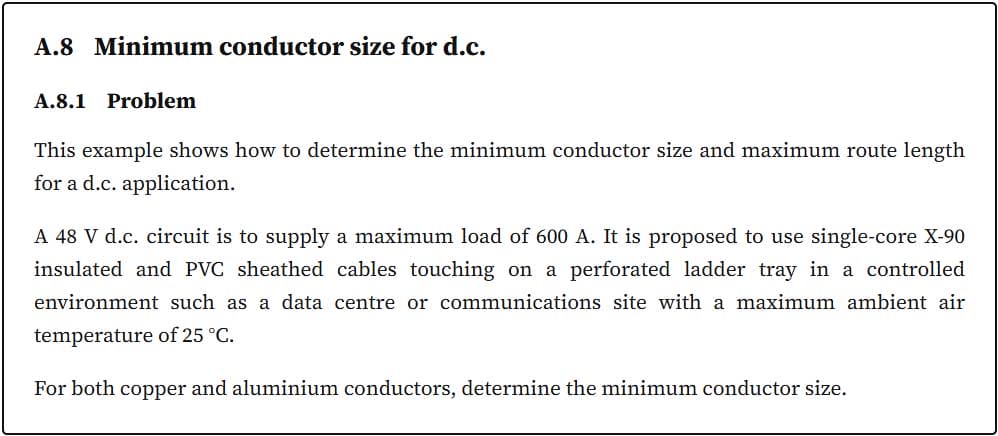
The cable sizing for copper and aluminium conductors follows the same principle; the output for copper conductors is used in the following analysis.
Similarly, the prompt should be developed based on the specified problem parameters and subsequently verified against the specialised input checklist.
Per Australian Standard 3008, size both the copper and aluminium conductors for a 48 V DC circuit with a maximum load current of 600 A over a 20 m route, with a maximum voltage drop of 8%. The cable is single‑core, X‑90 insulated and PVC‑sheathed, touching on a perforated cable tray. The maximum ambient air temperature is 25 degrees.
Figure 5: Case study 2. first prompt with the ambiguous installation description.
Assumptions and installation method
- Cable length: No length was specified, so 20 m was used as a representative installation length.
- Voltage drop: No permissible limit was provided, and the standard’s worked example calculates voltage drop without applying a compliance limit. An 8% limit was entered solely to prevent voltage drop from governing the cable selection.
- Installation method: The description “touching on a perforated cable tray” follows the standard. Under Table 3.5 of AS/NZS 3008.1.1:2025, cables “supported by trays” are assigned the same current-carrying capacity as cables installed “spaced from surface.”
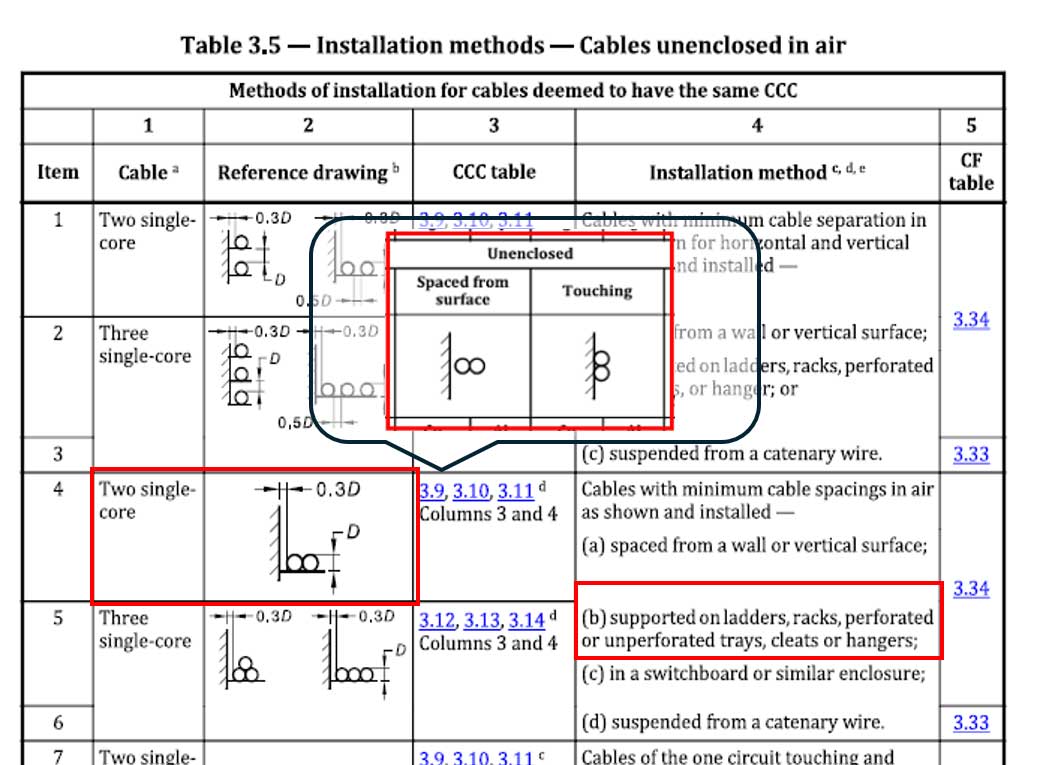
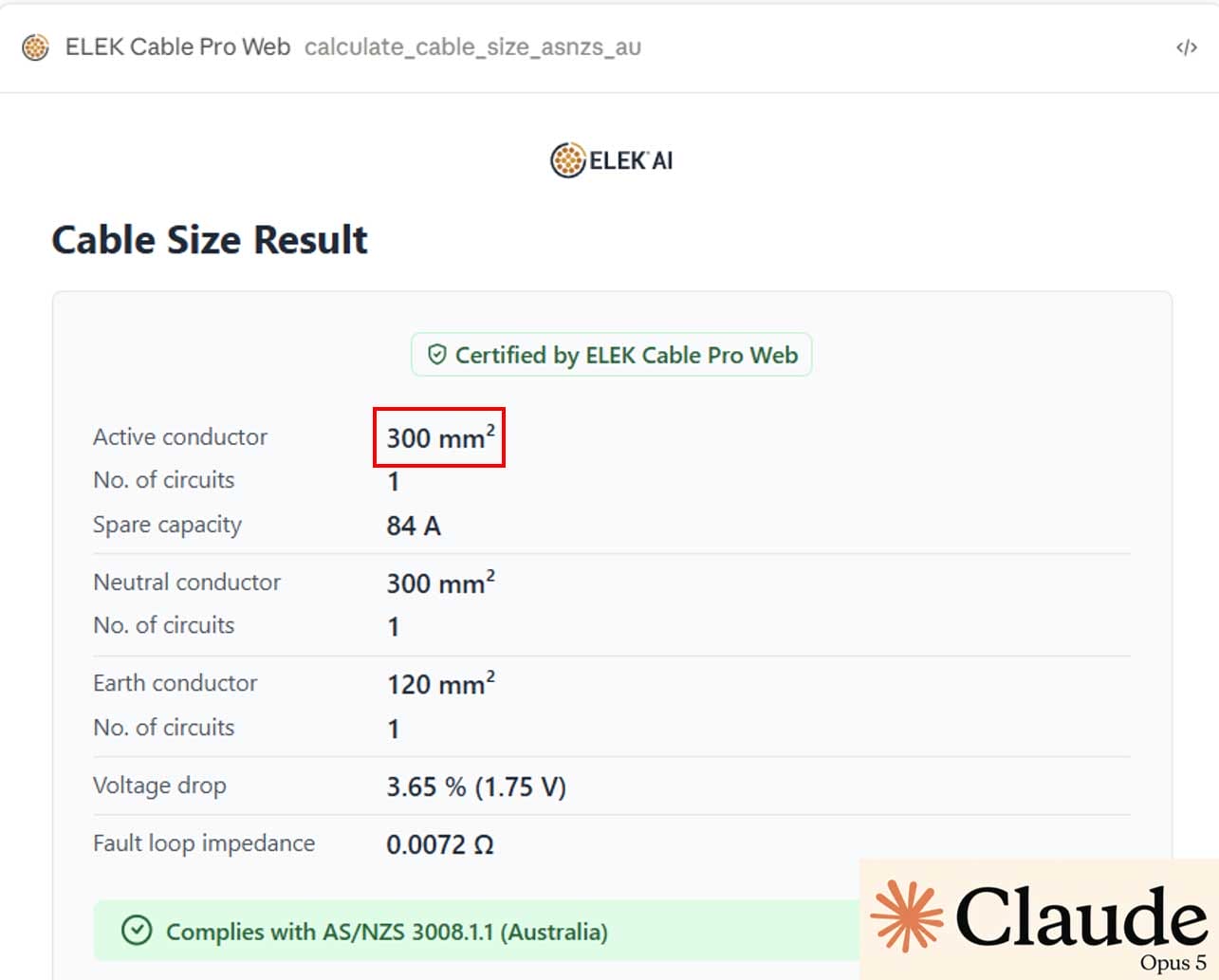
Because “Touching” is a specific term in the current-carrying capacity (CCC) table of the AS/NZS 3008.1.1 standard, the phrase “touching on a perforated cable tray” is more likely to lead LLMs to select “touching” as the installation method. Consequently, the model references the incorrect table, and eventually leads to incorrect cable sizing results (particularly since CCC is the dictating factor in this case).
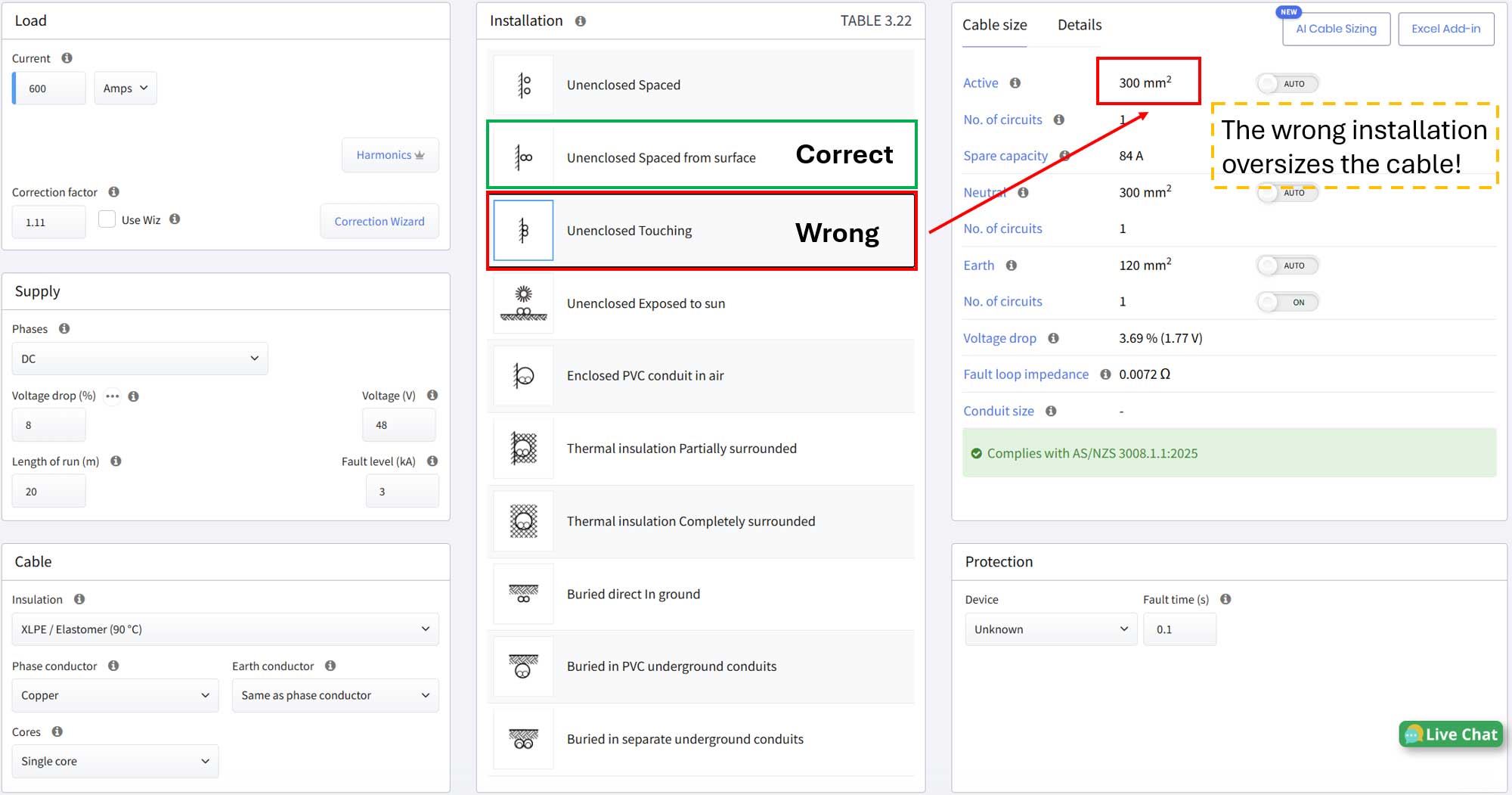
To solve this issue, the prompt should be refined to clarify the expression. In this case, modify the expression “touching on a perforated cable tray” to “supported by a perforated cable tray but spaced from the wall”, and keep other parts unchanged.
Per Australian Standard 3008, size both the copper and aluminium conductors for a 48 V DC circuit with a maximum load current of 600 A over a 20 m route, with a maximum voltage drop of 8%. The cable is single‑core, X‑90 insulated and PVC‑sheathed, supported by a perforated cable tray but spaced from the wall. The maximum ambient air temperature is 25 degrees.
Figure 9: Case study 2. second prompt with the installation description clarified.
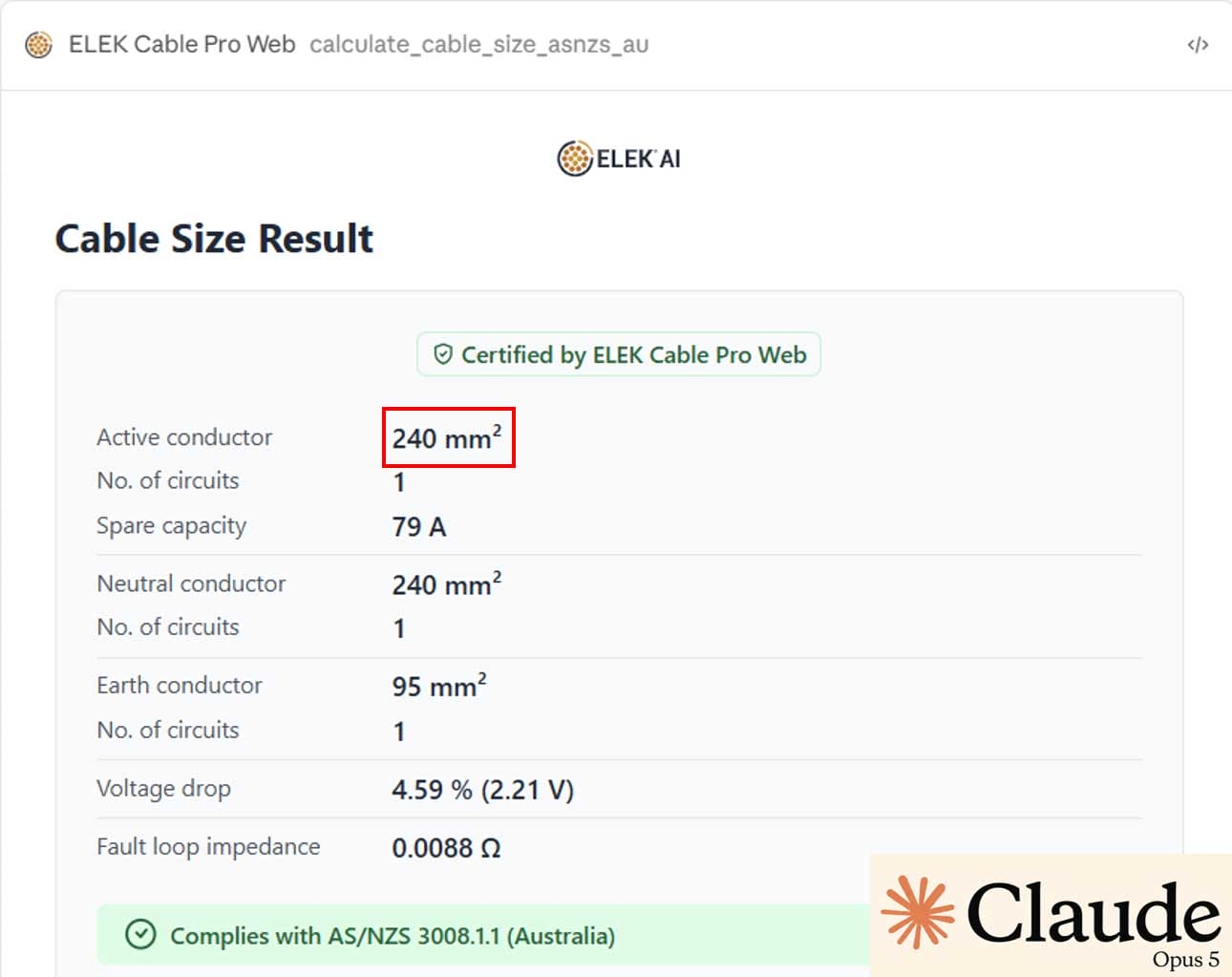
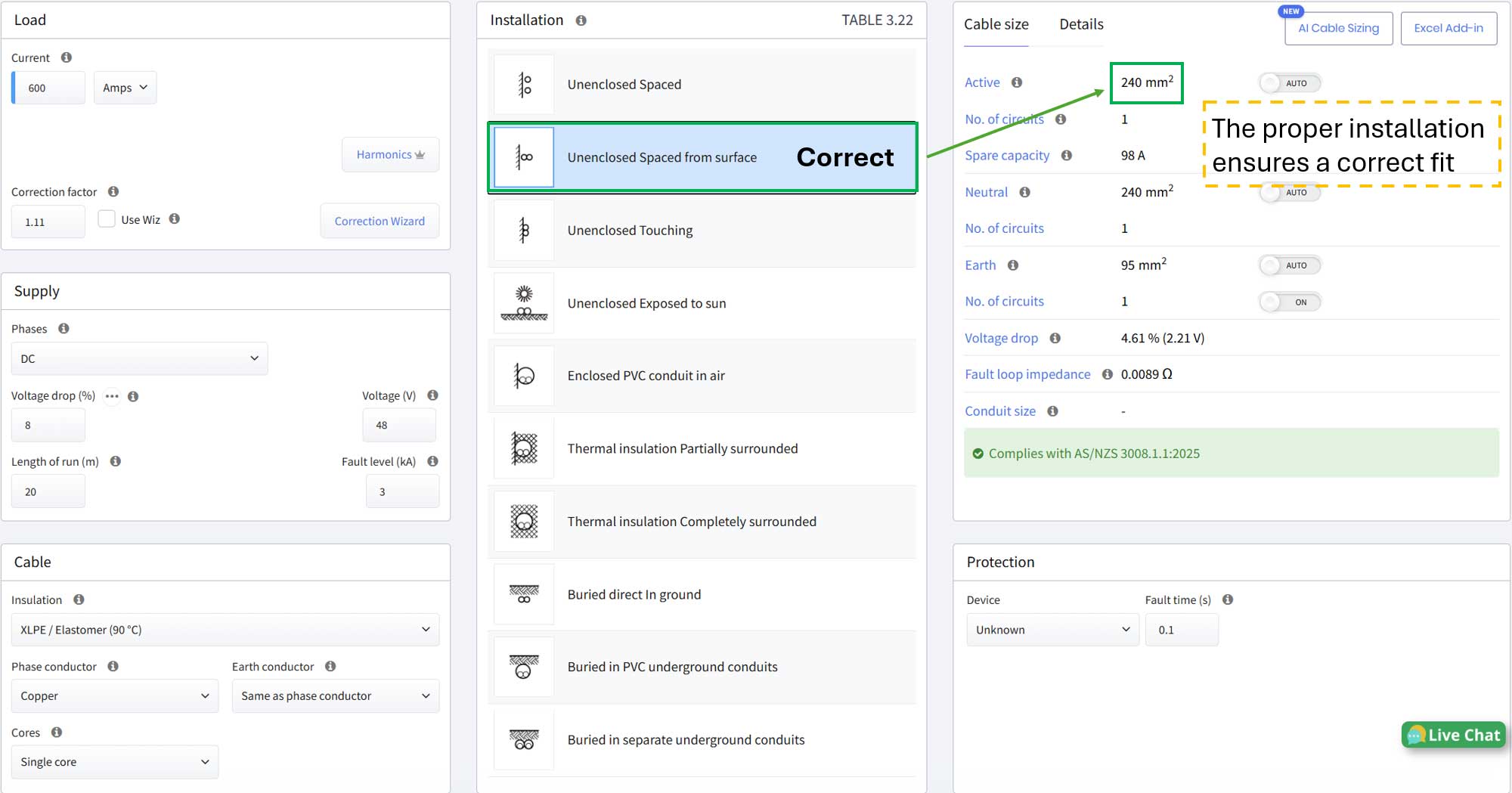
With the installation method correctly selected, the required active conductor drops from 300 mm² to 240 mm². In this case, an unclear prompt led to oversizing, and the cost was purely commercial. Had it gone the other way and been undersized, the consequence would have been a safety issue.
The table below compares ELEK AI and the general-purpose LLM (Claude Opus 5) with the same prompt (clarified).
| Answer | ELEK AI |
General-purpose LLM (Claude Opus 5) |
||||
|---|---|---|---|---|---|---|
| 1 | Standard | AS/NZS 3008.1.1:2025 | AS/NZS 3008.1.1:2025 | AS 3008.1.1:2017 | ||
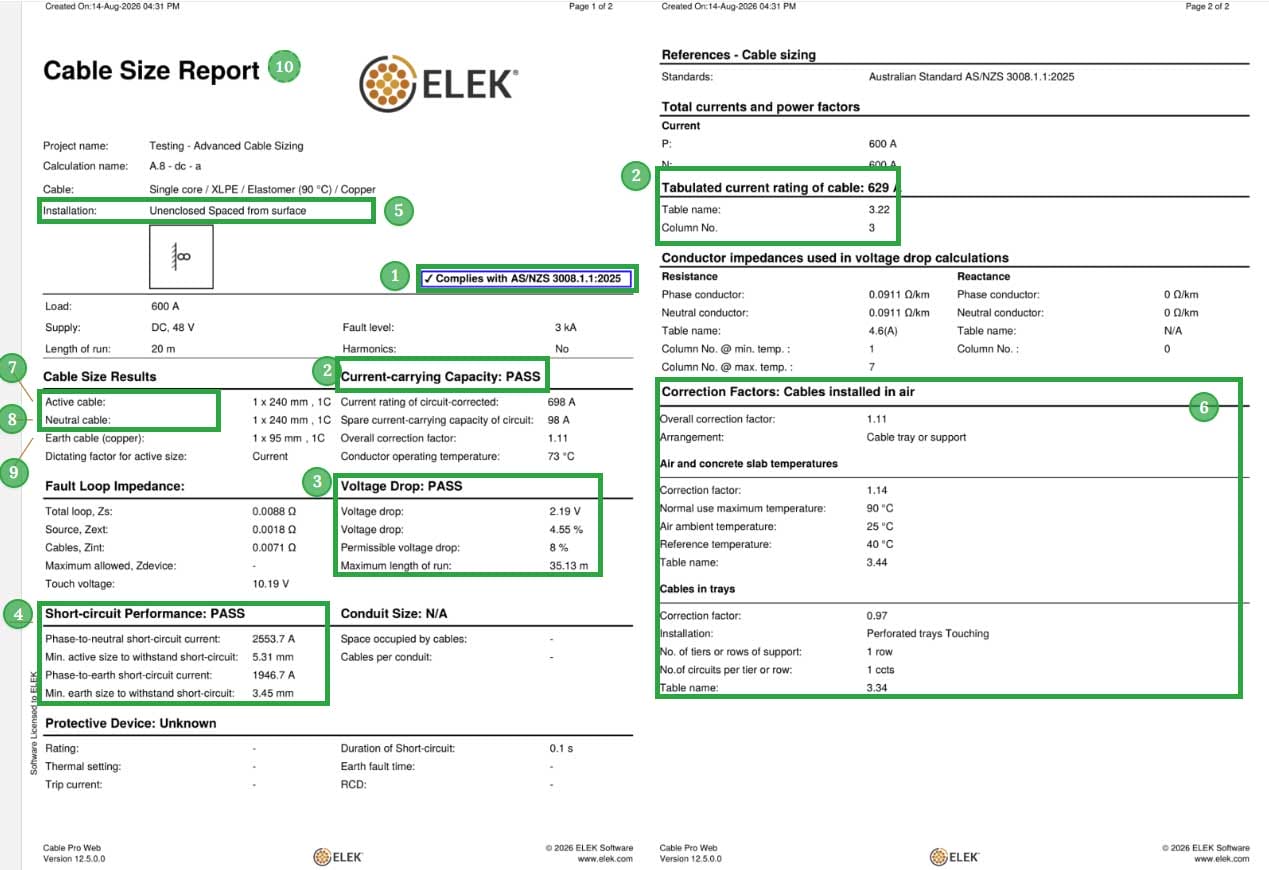
| 2 | Current-carrying Capacity Table | Current rating (tabulated): 629 A (Table 3.22 col. 3) | Current rating (tabulated): 629 A Table 3.22 col. 3 | "~465–530 A, marginal" (estimated) | ||
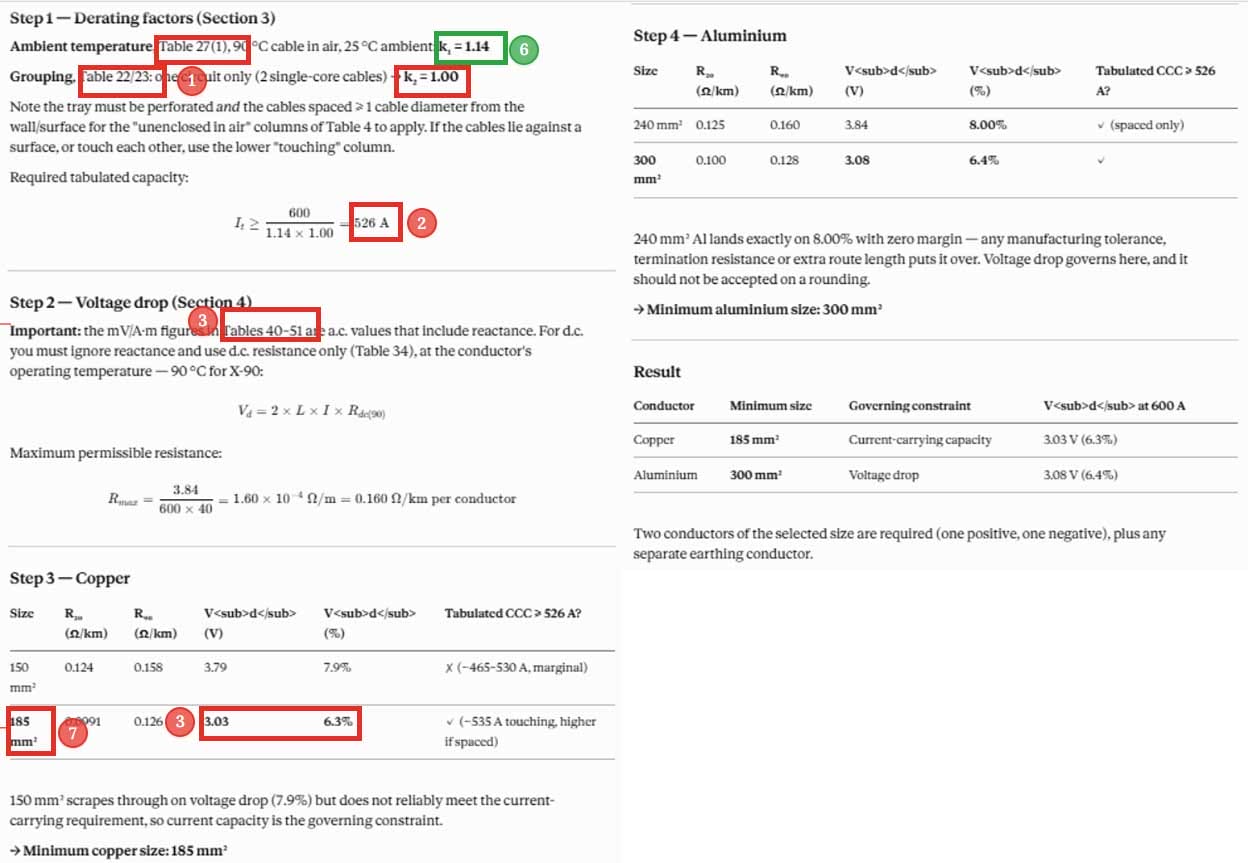
| 3 | Voltage Drop | 2.21 V; 4.61% | 2.21 V; 4.59%, pass the permissible value: 8% | 3.03 V (6.3%), the value is not right | ||
| 4 | Short-circuit Performance | active: 5.31 mm² neutral: 5.31 mm² earth: 3.45 mm² | Check the K factor from the latest standard and verify the minimum cross-sectional area by the equation: I²t = K²S² | Didn't verify | ||
| 5 | Installation | Unenclosed Spaced from the surface | Unenclosed Spaced from the surface | Column unresolved, user to verify | ||
| 6 | Correction Factor | 1.11 overall: 1.14 ambient (Table 3.44) × 0.97 in trays (Table 3.34) | 1.11 overall; 1.14 ambient (Table 3.44); 0.97 in trays (Table 3.34) | 1.14 ambient only, no tray leg | ||
| 7 | Active Size | 240 mm² | 240 mm² | 185 mm² | ||
| 8 | Neutral Size | 240 mm² | 240 mm² | N/A | ||
| 9 | Earth Size | 95 mm² | 95 mm² | N/A | ||
| 10 | Deliverable | Formatted report | Stamped PDF report with table references | Chat prose | ||
| 11 | Score | - | 10/10 | 0/10 | ||
In this case, ELEK AI achieved 100% accuracy again, whereas the general-purpose LLM failed to provide a correct solution. The detailed comparative results are highlighted and documented below.
Practical design procedure
- Install the cable sizing calculator MCP in your general-purpose LLM environment. See more details in our article: Connect ELEK Cable Pro Web AI to ChatGPT & Claude.
- Formulate the prompt based on your project requirements and confirm with the checklist.
- Polish the prompt to remove any ambiguity, particularly terminology used in the Standard.
- Review the computational results via the web interface or generate a comprehensive technical report for detailed validation.
- Execute comparative analyses or modify input parameters directly within the conversational interface.
Key engineering takeaways
- General-purpose LLMs can’t do precise cable sizing independently in our tests.
- Iterative cable sizing ensures compliance with capacity, voltage drop, thermal limits, loop impedance, and protection coordination.
- Get tabulated values from verified calculators and standards; the general-purpose LLMs are often unreliable.
- Leveraging detailed prompts to trigger a dedicated cable sizing Model Context Protocol (MCP) significantly enhances efficiency compared to manual data entry.
- Utilising a structured checklist ensures that all critical parameters are included, and a clear expression ensures that LLMs interpret it correctly.
Frequently asked questions
1. Can LLMs such as ChatGPT or Claude size a cable on their own?
No. Due to licensing restrictions on technical standards, these models lack direct access to official data tables and often approximate ratings from training memory rather than performing precise lookups. In one case study, a model generated a 36 A rating where AS/NZS 3008.1.1:2025 specifies 34 A. Furthermore, the model utilised the superseded 2017 edition without disclosure, omitted critical short-circuit checks, and failed to size neutral or earth conductors. While an LLM can interpret circuit specifications, calculations must be executed by a dedicated engine integrated with the verified tables.
2. How is the accuracy of the generated data verified?
With ELEK AI, all data points are fully traceable. The model extracts relevant parameters from the user’s description, while tabulated ratings, correction factors, and final dimensions are obtained directly from a calculation engine that consults specific standard tables for each value. The case studies presented in this article were validated against worked examples in AS/NZS 3008.1.1:2025, allowing for independent verification by any qualified professional with access to the standard.
3. Does the prompt significantly influence the calculation outcome?
Yes, the precision of the input prompt is critical. In the second case study, the specific phrasing “touching on a perforated cable tray” incorrectly triggered a selection from the “Touching” column rather than “Spaced from surface,” resulting in a 300 mm² calculation instead of 240 mm². Omitted parameters are populated with industry-standard defaults, such as 40 °C and 2.5% in the first case study, which are explicitly identified in the final report alongside user-provided data. While the arithmetic engine is deterministic, the accuracy of the result depends entirely on the specificity of the descriptive input.
4. Is the output of ELEK AI suitable for professional design and compliance documentation?
The computational output is fully auditable. The generated report documents every input parameter and references the corresponding standard tables, making it suitable for inclusion in design files. However, the system cannot verify that the described circuit accurately reflects the physical installation. Users must rigorously review the input table, especially default values, prior to finalising the design. ELEK AI mitigates computational risk but does not replace professional engineering judgment.
References
[1] Standards Australia / Standards New Zealand. AS/NZS 3008.1.1:2025 – Electrical Installations – Selection of Cables – Cables for Alternating Voltages up to and Including 0.6/1 kV – Typical Australian Installation Conditions. Sydney: Standards Australia.
[2] ELEK. Free Electrical Engineering Design Calculators. Available at: https://elek.com/calculators/
[3] Anthropic. Introducing Claude Opus 5. 24 July 2026. Available at: https://www.anthropic.com/news/claude-opus-5